
A Brief History of Cyprus
Cyprus has a rich and fascinating history, shaped by its position at the crossroads of Europe, Asia and the Middle East. Over thousands of years, the island has been influenced by ancient settlers, traders, empires and cultures, creating the unique heritage visitors can still experience today.
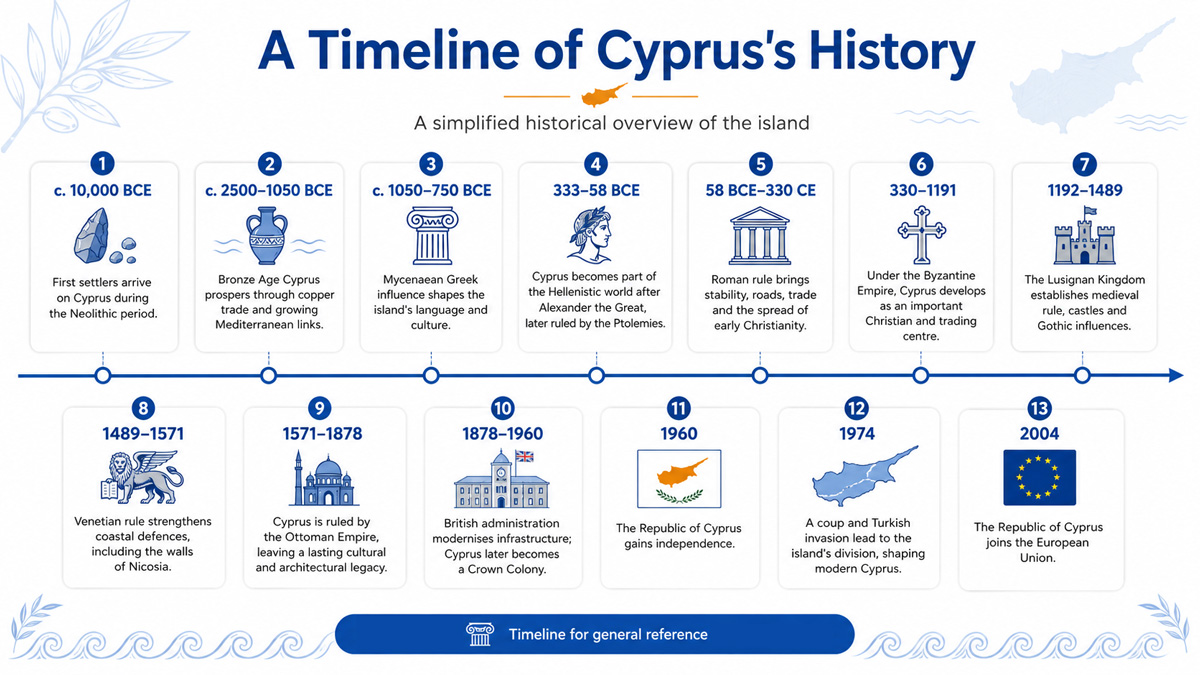
c. 10,000 BCE: The First Settlers
The story of Cyprus begins around 10,000 BCE, when the first settlers arrived during the Neolithic period. These early communities laid the foundations for life on the island.
c. 2500–1050 BCE: Bronze Age Prosperity
During the Bronze Age, Cyprus became an important centre for copper trade. Its natural resources helped the island build strong links across the Mediterranean, bringing growth, trade and cultural exchange.
c. 1050–750 BCE: Greek Influence
From around 1050 BCE, Mycenaean Greek influence helped shape the island’s language, culture and identity. This period played an important role in forming the character of Cyprus as it is known today.
333–58 BCE: The Hellenistic Period
After Alexander the Great, Cyprus became part of the Hellenistic world and was later ruled by the Ptolemies. This brought further Greek cultural influence and strengthened the island’s place within the wider eastern Mediterranean.
58 BCE–330 CE: Roman Rule
Cyprus came under Roman rule in 58 BCE. During this period, the island benefited from improved roads, trade, stability and the spread of early Christianity.
330–1191: The Byzantine Empire
Following the division of the Roman Empire, Cyprus became part of the Byzantine Empire. It developed as an important Christian and trading centre, with religion and commerce playing a major role in island life.
1192–1489: The Lusignan Kingdom
In the medieval period, the Lusignan Kingdom brought European influence to Cyprus. Castles, Gothic architecture and fortified towns became part of the island’s landscape, many of which still attract visitors today.
1489–1571: Venetian Rule
Venetian rule strengthened Cyprus’s coastal defences, including the famous walls of Nicosia. This period left a strong architectural legacy, particularly in the island’s historic towns and fortifications.
1571–1878: Ottoman Rule
From 1571 to 1878, Cyprus was ruled by the Ottoman Empire. This period left a lasting cultural and architectural influence, contributing to the island’s diverse heritage.
1878–1960: British Administration
British administration began in 1878 and brought changes to infrastructure, governance and public services. Cyprus later became a Crown Colony before moving towards independence in the mid twentieth century.
1960: Independence
In 1960, the Republic of Cyprus gained independence. This marked a major milestone in the island’s modern history and the beginning of a new chapter for Cyprus as a sovereign state.
1974: Division of the Island
Modern Cyprus has also been shaped by the events of 1974, when a coup and Turkish invasion led to the division of the island. This remains an important part of Cyprus’s recent history.
2004: Cyprus Joins the European Union
In 2004, the Republic of Cyprus joined the European Union, marking a significant moment in its modern development and strengthening its place within Europe.
Cyprus Today
Today, Cyprus is known for its beautiful coastline, warm hospitality, historic towns and unique cultural heritage. Its long and varied history makes it a memorable destination for visitors who want to enjoy both relaxation and discovery.
